
Kitchen Cabinet Materials Explained: Plywood vs. MDF vs. Particleboard
 22 min read
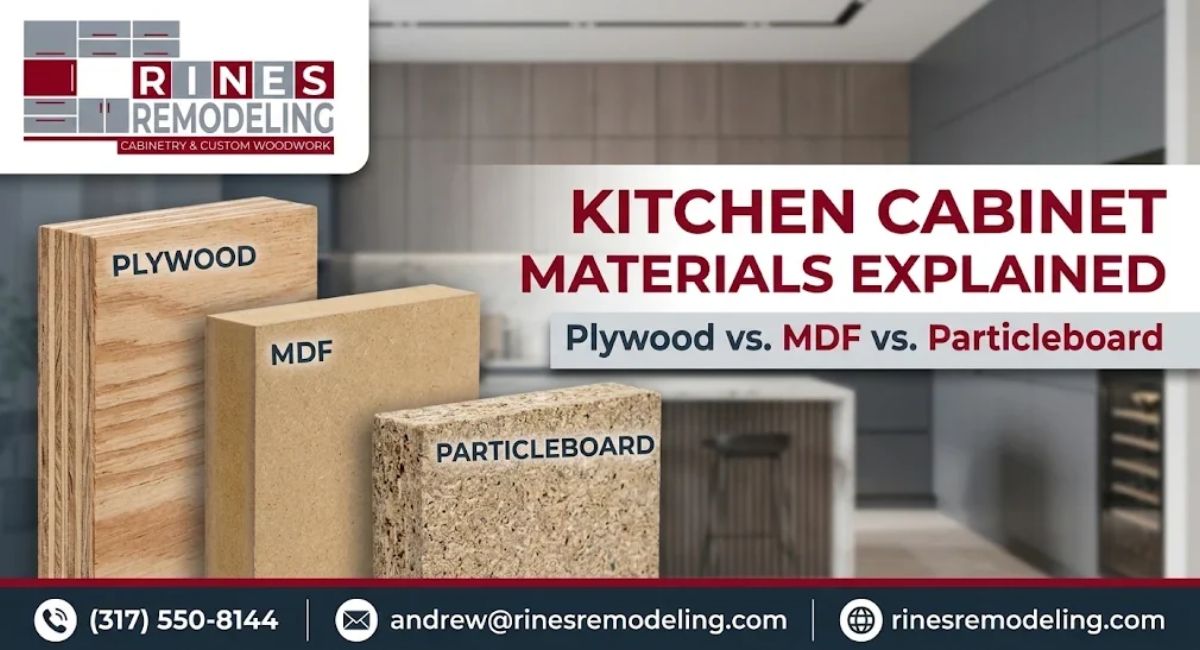
Two years after a kitchen remodel, a homeowner opens the sink cabinet. The floor of the box has swollen like a sponge. A slow drip from the supply line did it. The door hinge on the next cabinet has pulled loose too, and the screw holes are wide and crumbly.
The doors still look fine. The finish is still smooth. The problem sits underneath, in the material.
Most people shop for kitchen cabinets by color, style and price. Few ask what the box is made of. Yet that one choice shapes how the cabinets handle water, weight, daily use and years of door slams.
Three materials dominate the market: plywood, MDF and particleboard. Each has real strengths. Each has real limits. None is simply good or bad. The right pick depends on where the cabinet sits, what it holds and how it is built.
This guide explains how each material is made, how it performs, and where it fits best. It covers moisture, durability, hardware hold, finishes and build quality. It also lists practical checks you can run in a showroom. The goal is to help you read a spec sheet, not to push any one product.
First, Know What a Cabinet Is Made Of
A kitchen cabinet is not one piece of material. It is a set of parts. Each part has a different job.
- Cabinet box (carcass): The frame that holds everything. It includes the sides, top and bottom.
- Shelves: Carry the weight of dishes, pots and food.
- Back panel: Keeps the box square and closes the rear.
- Drawer boxes: Take daily pulling, pushing and loading.
- Doors and drawer fronts: The visible part. They take the finish.
- Face frame: A solid wood frame on the front of some cabinets. Frameless cabinets skip it.
Manufacturers often mix materials. A cabinet might use plywood for the box and MDF for painted doors. Another might use particleboard for the box and thermofoil doors.
So the real question is not “which material is best?” The better question is “which material is used for each part, and does it suit the job?”
Plywood: Layers With Crossed Grain
How It Is Made
Plywood is made from thin sheets of wood, called plies or veneers. Each layer is glued to the next. The grain of each layer runs at a right angle to the one below it.
This crossed grain is the key. It spreads stress in two directions. It also reduces the swelling and shrinking that solid wood shows across its width.
Hardwood plywood is the common choice for cabinets. The face layers may be birch, maple or oak. The inner layers may be softer wood. Cabinet makers use common thicknesses such as 1/2 inch, 5/8 inch and 3/4 inch for boxes. Back panels are often thinner.
Where Plywood Performs Well
Strength for its weight. Plywood resists bending and cracking well. Shelves hold heavy loads over longer spans.
Screw holding. Screws grip the long wood fibers. Hinges and drawer slides stay tight. If a screw hole wears out, you can often move the screw and keep going.
Handles moisture better than most boards. Plywood is not waterproof. But a short spill or a small leak is less likely to ruin it. It also tends to hold its shape after getting damp and drying out.
Lighter than MDF. A plywood box is easier to carry and hang.
Where Plywood Has Limits
Cost. Plywood usually costs more than particleboard and often more than MDF.
Quality varies. Plywood is not one product. Grades differ. Some sheets have voids, which are gaps in the inner layers. Voids weaken the panel and cause trouble when you cut or drive screws near an edge. Higher grade sheets use solid inner plies with fewer gaps.
Exposed edges need care. The layers show on cut edges. Makers cover them with edge banding or finish them. Raw edges absorb water faster than faces.
Surface can show grain. A painted plywood door can telegraph the wood grain. Painters often avoid it for flat painted doors.
MDF: Fine Fibers, Smooth Surface
How It Is Made
MDF stands for medium density fiberboard. Makers break wood into fine fibers. They mix the fibers with resin and wax. Then they press the mix into dense, flat sheets with heat.
The result has no grain. It is uniform from edge to edge and face to face. Fine cuts and routed shapes come out crisp.
Where MDF Performs Well
Smooth, flat surface. MDF takes paint beautifully. There is no grain to show through. This is why painted kitchen doors are so often MDF.
Stable across its width. MDF panels do not expand and contract with seasonal humidity the way solid wood does. A flat panel door with an MDF center stays flat.
Clean machining. Complex door profiles, raised panels and routed designs cut well in MDF.
Consistent quality. Good MDF has even density. You do not get knots or voids inside the sheet.
Where MDF Has Limits
Water is the enemy. MDF swells when it gets wet, especially at cut edges and bore holes. After it swells, it rarely returns to its original shape. Paint and sealer slow this down but do not stop long exposure.
Weak edge screw hold. Screws driven into the edge of MDF can split the board or strip the hole. Makers use pilot holes, special screws or dowels to help.
Heavy. MDF weighs more than plywood. A box made fully of MDF is hard to lift and puts extra load on wall anchors.
Not great for long shelf spans. MDF can sag under steady load, especially when thin.
Dust. Cutting MDF makes very fine dust. Shops and installers use dust control and masks.
Particleboard: Chips and Resin
How It Is Made
Particleboard is made from wood chips, shavings and sawdust. Makers mix them with resin and press them into sheets. The particles are larger and less uniform than MDF fibers. Many boards have finer particles on the faces and coarser ones inside.
Where Particleboard Performs Well
Low cost. This is the main advantage. It helps keep cabinets affordable.
Flat and consistent. The sheets are smooth and dimensionally stable when kept dry.
Works well with laminate. Many particleboard cabinets are covered in melamine. Melamine is a resin infused paper that bonds to the surface. It resists scratches and stains and comes in many colors and patterns.
Suitable for low stress parts. Upper cabinets that hold lightweight items often do fine with it.
Where Particleboard Has Limits
Moisture damage. Particleboard absorbs water quickly. When it swells, it does not recover. Sink bases and areas near dishwashers are risky.
Lower strength. It has less bending strength than plywood and MDF. Long shelves can bow.
Poor screw hold. Screws can pull out or strip. Repeated adjustment of a hinge can wear the hole.
Edges can chip. Edges chip more easily than plywood unless they are well sealed with edge banding.
Quality ranges widely. Dense, high grade particleboard with good bonding performs far better than a thin, loose board. Two cabinets both labeled “particleboard” may behave very differently.
Side by Side: How the Three Materials Compare
| Feature | Plywood | MDF | Particleboard |
| Structure | Layered wood veneers | Compressed wood fibers | Compressed wood chips |
| Moisture resistance | Better, but not waterproof | Poor at edges, swells | Poor, swells and stays swollen |
| Screw holding | Strong | Moderate, weak at edges | Weakest |
| Strength under load | High | Moderate | Lower |
| Weight | Moderate | Heavy | Moderate to heavy |
| Painted finish | Grain may show | Very smooth | Usually laminated instead |
| Relative cost | Highest | Middle | Lowest |
| Best use | Boxes, shelves, sink bases | Painted doors and panels | Budget boxes, dry areas |
This table is a guide. Brand, grade and construction can shift the result.
Moisture Resistance: Where Cabinets Fail First
Kitchens are wet places. Steam rises from pots. Dishwashers leak at the seals. Sinks drip. Refrigerator water lines can fail. Cleaning adds more water.
High Risk Zones
Some cabinets face more moisture than others.
- Sink base: The most exposed cabinet in the kitchen. Supply lines, drain lines and the garbage disposal all sit here.
- Dishwasher neighbors: Steam and seal leaks affect cabinets on both sides and the toe kick.
- Cabinet above the range: Heat and steam rise and affect the underside.
- Beside the refrigerator: Condensation or a water line leak can hit nearby cabinets.
- Toe kick area: Mop water and spills reach the bottom edges.
How Each Material Reacts
Plywood absorbs water more slowly. If you catch a leak early and dry the area, the box often survives. Long soaking can still cause layers to separate, which is called delamination.
MDF swells at the edges first. The swollen edge pushes through the paint and cannot be sanded back to a clean line. A swollen sink base floor in MDF often needs replacement.
Particleboard swells quickly and loses strength as it does. It crumbles when it dries.
Practical Protection
You can reduce risk with simple steps.
- Seal all exposed edges and cut holes, especially around plumbing.
- Use a waterproof liner or tray in the sink base.
- Choose plywood or a moisture rated board for the sink cabinet floor.
- Wipe spills fast, and check supply lines each year.
- Run a leak alarm near the dishwasher and sink.
- Fix small drips right away, because slow leaks cause the worst damage.
No material survives a long, hidden leak. The goal is to give the cabinet a better chance and to catch problems early.
Durability and Structural Strength
Durability is how a cabinet holds up over years of use. Three forces matter most: weight, racking and impact.
Weight
Cabinets carry heavy loads. Dishes, cookware, small appliances and canned goods add up fast. A shelf holding a stack of plates carries real weight.
Plywood shelves handle long spans better. A 3/4 inch plywood shelf can carry heavy items with little sag. Thinner particleboard shelves may begin to bow over time, especially on wide cabinets. Cabinet makers often add a center support or a front rail to limit sag.
Base cabinets also carry the countertop. Stone and quartz are heavy. The box and its joints need to support that weight without twisting.
Racking
Racking is a side to side twist. A cabinet that racks loses its square shape. Doors stop closing evenly. Drawers bind.
Plywood backs help hold a box square. A strong back panel glued and fastened into the box makes a big difference. Thin fiberboard backs stapled on loosely do less.
Impact
Kitchens see bumps. A dropped pan, a cart, a vacuum or a child’s toy can hit the lower cabinets. Edges and corners take the most abuse.
Plywood resists denting and chipping at edges. MDF and particleboard can chip or crumble at the corners. Good edge banding protects them.
Hardware Performance: Hinges, Slides and Screws
Hardware is where you feel material quality every day. Every door swing and drawer pull tests the box.
Hinges
A hinge screws into the cabinet side or the face frame. Door weight pulls on those screws every time the door opens. Heavy doors pull harder.
Plywood grips screws well. Hinges stay tight over time. If a screw hole loosens, a longer screw or a repositioned hinge often fixes it.
Particleboard and MDF grip screws less firmly. Repeated adjustments can strip the hole. Once stripped, the hinge may not hold. Repairs use wood filler, dowels or special inserts.
Many cabinet makers use hinge plates fixed with dowels or special fasteners to improve grip in board products.
Drawer Slides
Drawer slides carry the load of the drawer and its contents. A deep pot drawer can weigh a lot. The slides mount to the side of the cabinet box. Screws must hold under constant pulling.
Plywood sides hold slides securely. In particleboard, slides can loosen if the drawer is overloaded or yanked hard. Soft close slides add extra stress at the end of travel.
Pulls and Knobs
Door and drawer pulls rely on small screws. MDF doors usually hold them well because the core is dense. Particleboard doors hold them less well. Over time, pulls can loosen.
Adjustability
You will adjust hinges once or twice during the life of a kitchen. Doors settle. Houses shift. Humidity changes. A material that tolerates re-screwing is a real advantage. Plywood tolerates it best.
Surface Finishes: Veneer, Thermofoil, Melamine and Paint
The surface is not the same as the core. Most cabinets combine a core material with a surface layer. The surface affects look and care. The core affects strength.
Wood Veneer
Veneer is a thin slice of real wood glued to a substrate. It gives the look of solid wood at lower cost. Veneer can sit on plywood, MDF or particleboard. It can be stained or clear coated. Quality depends on the thickness of the veneer and the glue.
Thermofoil
Thermofoil is a vinyl film that is heated and pressed over an MDF door. It forms a seamless surface with no paint lines. It is easy to wipe clean.
Heat is its weak point. Steam, a toaster oven or a dishwasher venting nearby can cause the film to lift or peel at the edges. Thermofoil works best away from heat sources.
Melamine and Laminate
Melamine is a resin coated paper fused onto particleboard or MDF. It resists scratches and is easy to clean. High pressure laminate is a thicker layer bonded to the surface. Both come in solid colors, patterns and wood looks.
The edges are the weak point. If edge banding peels, water reaches the core.
Paint
Painted cabinets can sit on MDF, plywood or solid wood frames. MDF is a popular core for painted flat panels. The smooth surface takes a clean finish. Painted rails and stiles often use hardwood to resist cracks at the joints.
A factory baked finish tends to last longer than a brushed paint job. The hardness and cure are better controlled.
Stain and Clear Coat
Stain highlights wood grain. It works on solid wood and quality veneers. It does not suit MDF or particleboard because they have no grain.
Build Quality Matters as Much as the Material
Material is only part of the story. A well built particleboard cabinet can outlast a poorly built plywood one. Construction details decide a lot.
Look at these points.
- Box thickness: Sides of 1/2 inch are common in budget lines. 5/8 inch and 3/4 inch are sturdier. Thicker sides carry more weight and hold screws better.
- Joinery: Dowels, dado joints, glued rabbets and metal cam fasteners all work if done right. Staples alone are weak.
- Back panel: A thicker back, glued and fastened, resists racking.
- Shelf support: Check the thickness and the pin or clip system. Fixed shelves are stronger than adjustable ones.
- Edge banding: Banding should be tight, flush and well glued. Gaps invite water.
- Drawer box: Look at the material and the corners. Dovetail or doweled corners last longer than stapled ones.
- Toe kick: A water resistant toe kick protects the bottom of the box.
- Finish quality: The inside should be sealed or coated, not left raw.
A good cabinet shows care in the parts you do not see from the front.
Quality Standards Worth Knowing
The Kitchen Cabinet Manufacturers Association, or KCMA, runs a certification program tied to the ANSI/KCMA A161.1 performance standard. The standard tests cabinets for things like finish durability, door and drawer strength, shelf load and structural performance. A cabinet line with that certification has passed a set of repeatable tests.
Ask whether a line carries certification. It is not a guarantee of perfection. But it gives you a baseline that a spec sheet alone cannot.
Board products also have industry standards for density and strength. Panels used in cabinets typically follow published standards for particleboard and MDF, such as those from the Composite Panel Association. You do not need to memorize them. You can ask a supplier which standard a panel meets.
Air Quality and Formaldehyde
Composite wood products use resins. Some resins release formaldehyde, a gas that can irritate eyes, nose and throat at high levels. Plywood, MDF and particleboard can all contain such resins.
In the United States, federal rules limit formaldehyde emissions from composite wood products. The rules cover hardwood plywood, MDF and particleboard. Compliant products carry labels. California’s earlier program set limits that the federal rules follow.
Some manufacturers go further. They use resins with no added formaldehyde or ultra low emitting resins. If air quality matters to your household, ask for these details. Check the label and the product data sheet.
This is a general note. If someone in your home has asthma or chemical sensitivity, speak with a health professional about material choices.
Cost and Value: What You Pay For
Price follows material and build quality. As a general pattern:
- Particleboard cabinets cost the least.
- MDF based cabinets cost more, especially with painted finishes.
- Plywood cabinets usually cost the most.
This does not mean the cheapest option is poor, or that the priciest is flawless. A budget kitchen with good particleboard boxes, sealed edges and careful installation can serve a dry, low use kitchen well. A rental or a quick refresh may not justify the cost of plywood.
On the other hand, a kitchen you plan to keep for 15 years or more may justify the stronger material. This is especially true for the sink base and heavy use cabinets.
Think about the cost of failure. Replacing a swollen sink base later means labor, demolition and sometimes countertop work. A bit more spent up front on the right material can prevent that.
A written estimate helps here. It should list the cabinet material, the thickness, the finish and the hardware. An estimate checklist for remodeling shows what an estimate should include, so you can compare bids on equal terms and spot vague line items.
Matching Material to Situation
Examples make the trade offs easier to see.
A Busy Family Kitchen
A family of five cooks daily. The kids slam doors and hang on drawers. The dishwasher runs every night. They plan to stay in the house for many years.
Better fit: Plywood boxes, at least 5/8 inch thick, with a plywood back. Painted MDF or hardwood doors. Plywood drawer boxes. The extra strength handles daily abuse. Hinges stay tight.
A Quick Refresh Before Selling
A homeowner plans to list the house in a year. The existing layout works. The cabinets look dated.
Better fit: Standard cabinets with good quality particleboard or MDF boxes, durable laminate or thermofoil doors, and good hardware. The goal is fresh appearance and fair durability, not a lifetime build. Resurfacing existing cabinets may also be an option.
A Kitchen With a Wet Sink Zone
A couple loves to cook and wash by hand. They run the faucet often and keep the sink cabinet packed with cleaning supplies. Their last kitchen had a swollen sink base.
Better fit: A plywood sink base with a sealed interior and a waterproof tray. Even if the rest of the cabinets use a different material, this one cabinet deserves the stronger choice. Add a small leak alarm.
A Painted White Kitchen on a Mid Range Budget
A homeowner wants flat panel painted doors. Plywood doors would show grain through the paint.
Better fit: MDF flat panel doors with a hardwood frame. Plywood boxes inside. This mix gives a smooth painted look and strong boxes. Seal all door edges, because MDF swells when exposed.
A Garage or Laundry Room Cabinet Run
A homeowner wants cabinets in a laundry room. The room sees humidity, spills and a washer that may leak.
Better fit: Plywood or a moisture resistant product. Laminated surfaces. Sealed edges and a raised base. Avoid raw particleboard in a damp space.
Mixed Construction: Why It Is Common and Often Smart
Many quality cabinet lines mix materials on purpose.
- Plywood box with MDF doors: Strong structure, smooth painted face.
- Plywood box with solid wood face frame: Strong and traditional.
- Particleboard box with plywood sink base: Budget friendly with protection where needed.
- Plywood box with veneered doors: A wood look with stable panels.
This approach puts the right material in the right place. It is not a shortcut. It is a design choice.
Ask what each part of the cabinet uses. Do not stop at “plywood” or “MDF” as a single label.
Common Myths About Cabinet Materials
MDF is always poor quality. Not true. Good MDF performs well in painted doors and panels. The problem is using it in the wrong place, such as a sink base.
Plywood is always better. Not always. Cheap plywood with voids can disappoint. A well made MDF door can look better than a rough plywood one.
Particleboard is unusable. Not true. Quality particleboard in a dry, well built cabinet can serve well. It just has less margin for water and abuse.
Solid wood beats everything. Solid wood is beautiful. But wide solid wood panels move with humidity and can crack or warp. That is why many makers use plywood or MDF for large panels.
Thicker always means better. Thickness helps, but density and quality of the board matter too.
How to Check Cabinet Quality in a Showroom
You do not need special tools. A few simple checks reveal a lot.
- Look at the edges. Open a drawer and look at the cut edges inside. Check for layers, fibers or chips.
- Feel the weight. Lift a door or a box. A light, flimsy feel can signal thin material.
- Check the thickness. Measure the side panel. Ask for the actual dimension.
- Press the back panel. It should feel solid, not flexible.
- Open and close a drawer. It should glide smoothly with no wobble.
- Look inside the sink base. Check the floor material and the sealing of the edges.
- Ask for a cutaway sample. Many makers have a sample that shows the core and joinery.
- Check the finish inside. Raw interiors absorb moisture more easily.
- Ask about the warranty. Read what it covers, including water damage.
Questions to Ask Your Contractor or Cabinet Supplier
Bring a short list to your first meeting.
- What material is used for the box, shelves, back and drawer boxes?
- What thickness is each part?
- Does the line carry KCMA certification?
- What are the doors made of, and what is the finish?
- How are the sink base and dishwasher area protected?
- What does the warranty cover, and for how long?
- What formaldehyde compliance labels apply to the panels?
- Can I see a cutaway sample or a finished display?
Clear answers show a supplier who knows the product. Vague answers are a warning sign.
Frequently Asked Questions
Is plywood better than MDF for kitchen cabinets?
Plywood is usually better for cabinet boxes, shelves and sink bases. It is stronger, holds screws better and handles moisture better. MDF is often better for painted doors because the surface is smooth. Many cabinets use both.
Is MDF good for kitchen cabinets?
Yes, in the right parts. MDF works well for painted doors and panels. It is a poor choice for areas with repeated water exposure, such as sink bases.
Is particleboard bad for kitchen cabinets?
Not always. Quality particleboard can work in dry areas and lighter use cabinets. It is less forgiving with moisture, weight and repeated hardware adjustment.
Which cabinet material handles moisture best?
Plywood generally handles moisture better than MDF or particleboard. None of them is waterproof. Sealing edges and fixing leaks quickly matter for all materials.
What is the most durable cabinet material?
Plywood is generally the most durable of the three for boxes. Solid wood and high quality hardwood frames add strength to doors and face frames. Durability also depends on thickness and construction.
What is thermofoil made of?
Thermofoil is a vinyl film heat pressed over an MDF core. It offers a smooth, seamless surface. It can lift near heat sources, so keep it away from ovens and dishwasher vents.
Do plywood cabinets cost more?
Yes, usually. Plywood tends to cost more than MDF or particleboard. The higher price buys strength, screw hold and moisture tolerance.
Can I mix materials in one kitchen?
Yes. Many well built kitchens do. A plywood sink base with other cabinets in a different material is a common way to spend money where it matters most.
Are composite wood cabinets safe for indoor air?
Federal rules limit formaldehyde emissions from composite wood products sold in the United States. Look for compliance labels. Ask about low emitting options if air quality is a concern.
How Cabinet Choices Fit Into a Full Remodel
Cabinets are one of the largest line items in a kitchen remodel. They also shape the schedule. Custom and semi custom lines can take weeks to build and ship. Delays affect the whole project.
A good plan sets the cabinet order early. A home remodeling timeline by phase shows where design, ordering, demolition and installation usually fall. Knowing the order helps you avoid costly delays.
Cabinet decisions also connect to countertops, flooring, plumbing and lighting. If you plan to change the layout or open a wall, you may need to coordinate several trades. Some homeowners include the kitchen in a larger full home remodeling plan so finishes and materials stay consistent from room to room.
For work focused on the kitchen itself, kitchen remodeling in Westfield, IN services can cover cabinet selection, layout, counters, plumbing and electrical in one scope. The main home remodeling services page shows the full range of project types.
Choose Materials That Match the Job
Plywood, MDF and particleboard each have a place. Plywood brings strength, screw hold and better moisture tolerance. MDF brings a smooth surface that suits painted doors. Particleboard brings a lower price and works in dry, lighter use settings.
The smartest choice is rarely one material for every part. It is the right material for each part. Put plywood where water and weight are a threat. Use MDF where a smooth paint finish matters. Save with particleboard only where it will stay dry and lightly loaded.
Before you sign for cabinets, ask what each part is made of. Check the thickness, the edges and the back panel. Look at the sink base first. Request the warranty in writing and read what it covers.
If you want a second opinion on cabinet materials, layout and budget, the team at Rines Remodeling can review your plans and explain the options in plain terms. Visit the Indianapolis kitchen remodeling services page to see how a planned, step by step process helps you get cabinets that look good and hold up.